
Why Monday's numbers look like that
The Monday reading is higher than the rest of the week, most weeks. It is not a verdict on your weekend, and there is usually something specific behind it.

Monday morning. You check, and the number is higher than it was on Thursday, and higher than it was the Monday before that.
There is a familiar feeling that comes with it, somewhere between guilt and resignation, followed by a quick internal review of everything you have eaten since Friday.
Put that down for a minute. The Monday number is real, it usually has a specific cause, and the cause is almost never that you are bad at this.
Two days is long enough to move a number
A weekend is a small holiday from a routine, and a routine is most of what your readings are measuring.
Between Friday evening and Monday morning, several things change at once. Meals move later and get bigger. Sleep gets longer, or shorter, and lands at different hours. There is often alcohol. There is often much more sitting, or much more walking than a desk week involves, and either one shows up. Coffee happens at eleven instead of seven. Someone else cooks.
Any one of those moves a reading a little. Together they move it enough to see, and because they happen every weekend, they arrive as a pattern rather than as noise. A pattern feels like a judgement. It is closer to a weather report.
Monday is not a verdict on Saturday. It is one reading, taken after a different two days.
The dose that quietly slipped
This is the one to look at first, because it is the most common and the least often mentioned.
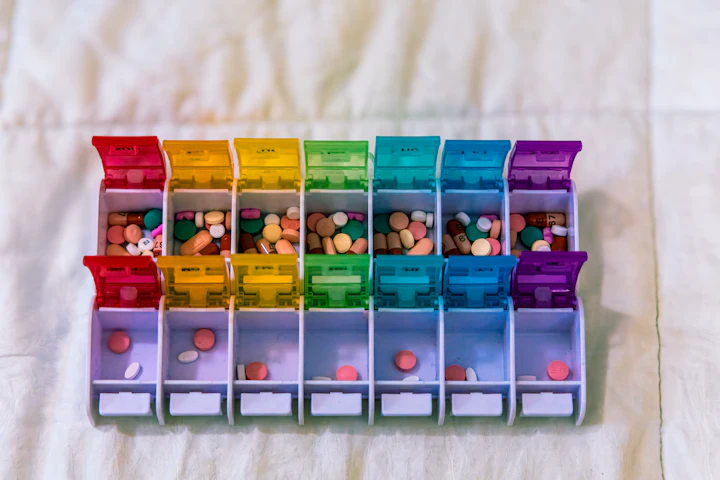
Weekday medication is usually attached to something else: the alarm, the coffee, the drive, the lunch break. On Saturday those anchors are gone. A dose gets taken two hours late, or after breakfast instead of before it, or in the evening rush, or not at all, and by Monday nobody remembers which of those it was.
That is not a character flaw. It is what happens when a habit is glued to a routine that stops on Friday. It does change your numbers, though, and it is exactly the kind of detail people leave out when they report how the week went, which means their care team ends up looking at a pattern with the explanation missing.
Say it plainly instead. It is a common thing to say, and the fixes are practical: a different reminder, a pill organiser you fill on Sunday, or in some cases a different schedule, which is a change only the prescriber can make.
On missed doses, what to do depends entirely on the medication. Some have a straightforward rule and some do not, and a few are genuinely unsafe to double up. Ask your pharmacist for the rule for each of yours and write it down now, while nothing is happening, rather than deciding it in the moment.
Sleeping in is not the same measurement
A fasting reading taken at half past nine on Sunday is not the same measurement as a fasting reading taken at half past six on Wednesday. More time has passed since your last meal and since your last dose, your body has been further through its own morning hormone rhythm, and you are comparing the two as though they were the same thing.
Weekend alcohol adds another layer, and it works in the opposite direction to what most people expect. If you take insulin or a sulfonylurea such as gliclazide, glyburide or glimepiride, alcohol can pull blood sugar down for hours after the drinking has stopped, including overnight and into the next morning. That is worth knowing about a Sunday morning low, and it is more worth knowing before Saturday night.
So the honest comparison is weekend against weekend, and weekday against weekday. Two Mondays tell you considerably more than a Monday held up against a Thursday.
What the weekend does to blood pressure
The same logic applies, with a slightly different list.
Restaurant and takeout food carries far more sodium than home cooking, and sodium shows up in blood pressure over a day or two rather than immediately. Alcohol raises it. Short or shifted sleep raises it. A late morning coffee sits much closer to a late morning reading than a seven o’clock coffee does to a seven o’clock reading.
If you take your blood pressure at home, take it at the same times on the weekend as on weekdays, or at the very least write down when you took it. A reading captured at a random hour on Sunday, just after coffee, is not comparable to your weekday series, and mixing it in makes the whole series harder to read.

Worth a word with your care team
Most weekend drift is information rather than a problem, and the right home for it is your next conversation rather than a phone call today.
Raise it if the same difference turns up over several weekends, if your weekend or Monday morning readings are running low rather than high, if you have signs of an overnight low after drinking such as waking sweating, a pounding heart, or a headache in the morning, or if you have noticed you are regularly missing or delaying weekend doses.
Call sooner than that for a very high reading with vomiting, deep or rapid breathing, drowsiness or breath that smells fruity, or for a low you cannot bring back up. Treat a low first and report it afterwards. Do not wait to be told to.
One more thing, because it happens just as often as the other version. Some people’s weekend numbers are better than their weekday ones: more sleep, more movement, less work stress. That is information too, and it is arguably the more useful kind, because it is telling you something about the five days rather than the two.
One small place to start
For the next two weekends, change nothing at all. Just add a few words to your readings: what time you actually woke up, whether the dose was on time, and whether there was alcohol.
Then look at your two Mondays next to each other, rather than against the middle of the week.
If you are a 360Care member, bring those two weekends to your care team in the app. Most of the time we can point at the one thing that is moving it, and most of the time it is smaller and more fixable than it feels at half past seven on a Monday morning.